New open-source release: OpenSeesPy 2D RC Frame Optimizer
A new open-source tool from the ARtIStE group is now archived on Zenodo and available on GitHub. The OpenSeesPy 2D RC Frame Optimizer automates the complete seismic workflow for planar reinforced concrete frames, from model generation through Eurocode verification to the selection of a cost-optimal retrofit strategy and finalizing with an almost professional and complete report which contains the be best five soloutions.
Developed by Arman Hajiha and Giuseppe Carlo Marano, DISEG, Politecnico di Torino. September 2026
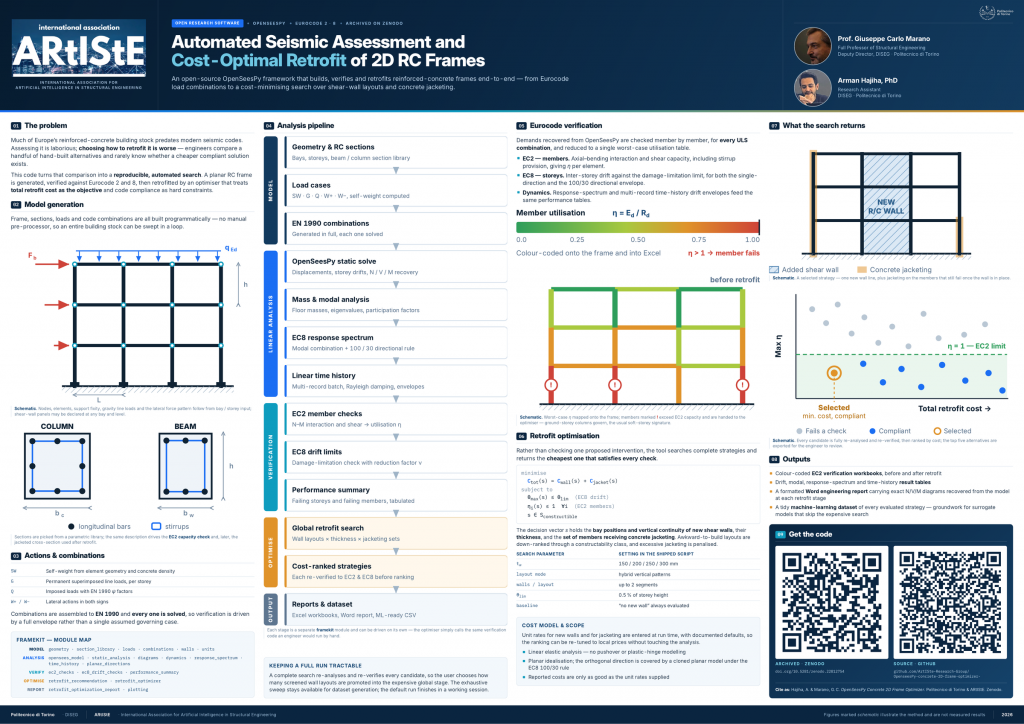
More information about our Code/Software
Why it was built
Most of Europe's reinforced-concrete building stock predates modern seismic codes. Assessing it is laborious, but deciding how to retrofit it is harder still: in practice engineers compare a handful of manually prepared alternatives and rarely know whether a cheaper compliant solution exists. This tool turns that comparison into a reproducible, automated search.
From model to verification
The frame, its cross sections, loads and code combinations are all built programmatically, with no manual pre-processor, so an entire building stock can be swept in a loop. Self-weight is derived from the element geometry; permanent, imposed and lateral actions are assembled into EN 1990 combinations, and every combination is solved rather than assuming a single governing case.
Verification then proceeds on two fronts. At member level, demands recovered from OpenSeesPy are checked to Eurocode 2 for axial–bending interaction and for shear including stirrup provision, producing a utilisation ratio for each element. At storey level, inter-storey drifts are checked against the Eurocode 8 damage limitation, both for a single direction and for the 100/30 orthogonal envelope. Modal analysis, response-spectrum analysis and multi record (in base code we have putted one record from elcentro) linear time-history analysis with Rayleigh damping all feed the same performance tables.
The optimisation
Rather than checking one proposed intervention, the optimiser evaluates complete strategies. The decision variables are the bay positions and vertical continuity of new shear walls, their thickness, and the set of members receiving concrete jacketing. The objective is the total retrofit cost walls plus jacketing and code compliance enters as hard constraints: the inter-story drift limit and a member utilisation not exceeding unity.
Every candidate is fully re analysed and reverified before being ranked, so the comparison is made on real structural response rather than on approximations. Layouts that would be awkward to construct are down ranked through a constructability class, and excessive jacketing is penalised. A "no new wall" baseline is always evaluated, and unit rates are entered at run time so the ranking can be re-tuned to local prices without touching the analysis.
What it produces
Colour coded Eurocode 2 verification workbooks before and after retrofit; drift, modal, response-spectrum and time-history result tables; a formatted engineering report carrying exact internal force diagrams recovered from the model at each retrofit stage; and a machine learning ready dataset of every strategy evaluated intended as groundwork for surrogate models that can eventually bypass the expensive search.
Scope
The analysis is linear elastic; pushover and plastic hinge modelling are outside its scope. The idealisation is planar, with the orthogonal direction covered by a cloned planar model under the Eurocode 8 100/30 rule.
Reported costs are only as reliable as the unit rates supplied.
Availability
Archived on Zenodo with a permanent DOI and developed openly on GitHub.